




Question #4: Are hair
extensions recommended for
my thinning top hair?
Answer #4: In general, the
answer is no, unless your hair is
curly and short. The reason is
that attaching hair extensions to
your existing hair, requires the
technician to use a cylinder tube,
glue, tape or even a hair clip.
For those who have thin hair on
top, these methods of
attachment show through your
hair because a hair extension is
simply a group of thin strands of
hair in a round or flat form.
However, for those who have
short and curly hair, the thin hair
on top can be easily covered by
using extensions.
 Question #5: What is the
right type of Human Hair
Extension to choose?
Answer #5: It is important to
choose the right type of hair
extension based on your hair
condition, style, and how it fits
into your life style. Therefore, it
is important to consult with a
hair professional who covers
both the field of hair extensions
and hair replacement.
Question #6: If hair
extensions are not right for
me, what other method
should I consider?
Answer #6: You need to talk to a
hair replacement specialist who
knows hair extension techniques
as well. Hair replacement is a
unit that goes on top of the head
to increase density naturally. If a
person has thin hair on top or in
the crown area, the proper way
to go is a partial hair piece or a
top piece. A full wig is designed
to cover an entire head while the
partial unit is designed to cover
an exact area of thin hair or bald
area. Note: Watch for the
upcoming release of our
exciting new product
designed to meet these
needs! Be sure to join our
email list.
Question #7: What types of
Human Hair are being used
for hair extensions?
Answer #7: There are several
different types of human hair
being used in the current
marketplace. The main sources
are India and China while
European human hair is limited
in quantity. You can choose
Cuticle-Intact human hair which
is healthier than chemically
stripped human hair that has
been collected from cuticles with
inverted hair (this type of hair is
usually weaker than cuticle-
intact hair and has a tendency of
matting/tangling. Note: Our
product is made of the
highest quality of cuticle-
intact hair and has minimal
processing.
Question #5: What is the
right type of Human Hair
Extension to choose?
Answer #5: It is important to
choose the right type of hair
extension based on your hair
condition, style, and how it fits
into your life style. Therefore, it
is important to consult with a
hair professional who covers
both the field of hair extensions
and hair replacement.
Question #6: If hair
extensions are not right for
me, what other method
should I consider?
Answer #6: You need to talk to a
hair replacement specialist who
knows hair extension techniques
as well. Hair replacement is a
unit that goes on top of the head
to increase density naturally. If a
person has thin hair on top or in
the crown area, the proper way
to go is a partial hair piece or a
top piece. A full wig is designed
to cover an entire head while the
partial unit is designed to cover
an exact area of thin hair or bald
area. Note: Watch for the
upcoming release of our
exciting new product
designed to meet these
needs! Be sure to join our
email list.
Question #7: What types of
Human Hair are being used
for hair extensions?
Answer #7: There are several
different types of human hair
being used in the current
marketplace. The main sources
are India and China while
European human hair is limited
in quantity. You can choose
Cuticle-Intact human hair which
is healthier than chemically
stripped human hair that has
been collected from cuticles with
inverted hair (this type of hair is
usually weaker than cuticle-
intact hair and has a tendency of
matting/tangling. Note: Our
product is made of the
highest quality of cuticle-
intact hair and has minimal
processing.
Ask B.J.
Question #1: Who can
benefit from 100% Human
Hair Extensions?
Answer #1: Those individuals
who wish to thicken and/or
lengthen the sides and back of
their hair. Also, our pieces are a
perfect solution for those who
want to change their look and
style without making permanent
modifications to their own hair.
Question #2: What is the
main purpose and function of
Hair Extensions?
Answer #2: The basic purpose of
hair extensions is to increase the
length and provide more volume
to the client’s existing hair.
Question #3: What types of
Hair Extensions are available
on the market and how do I
choose the right type and
attachment method for me?
Answer #3: Basically, there are
4 types that are widely available
now.
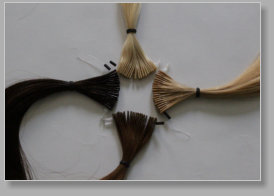
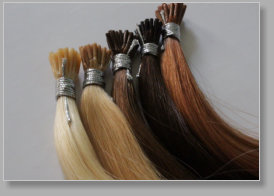
Cylinder tube/”micro ring”
method: These are attached by
using a small tube made out of
coated aluminum or copper,
each with pre-glued hair
strands. The strands are then
pushed onto a cylinder tube
after a piece of the individual’s
own hair is pulled onto the
cylinder. Pressing the round
cylinder flat locks the hair
extension onto existing hair.
Note: Our products include
this type of hair extension.
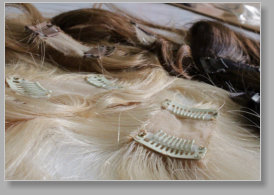
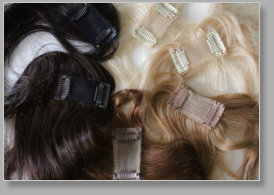
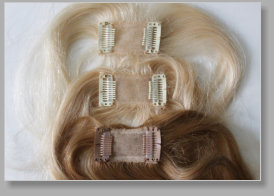
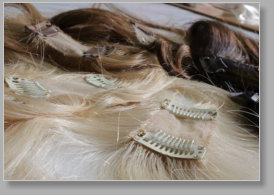
Clip in method: A skirt-like hair
drape is pre-attached with small
clips. You can then simply clip it
in onto your existing hair. You
may use one layer or two layers
depending on the required
density. Clip in extensions come
in two different strip widths –
short or long. It takes only a
few seconds to install onto
existing hair by simply snapping
it on, but like eye glasses, you
may need to remove it at night.
It’s the easiest extension to use
and you can try it on by
yourself. This is also the most
economical way to consider hair
extensions before you decide to
permanently attach them. Clip in
extensions outlast any other
types of hair extension and no
maintenance service is required
other than to shampoo it once in
a while. Note: Our products
include this type of hair
extension.
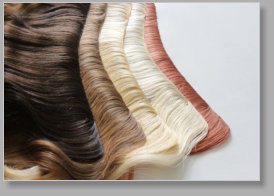
Conventional weave/braid
method: Using machine made
weft, the technician sews a hair
skirt-like weft onto the client’s
existing track line. The process
of track line sewing can pull
existing hair, creating traction
Alopecia. Therefore, this
method is not recommended for
those who have weak hair. For
those who have strong hair, the
method can be beneficial and
machine made hair is rather
inexpensive.
Glue method: Using pre-glued
individual extensions in a round
or U shape form, each piece is
individually attached to the
same amount of client hair by
applying heat, causing the
melted glue to attach on to the
hair. Attaching is simple, but
removing the extension can be a
problem depending on the type
of glue being used or the
technician’s technique. The
technician may use a solvent or
removing oil which can stress
and damage weak hair. Smaller
tiny glue extensions can be used
in the frontal area or temple
area of the head.
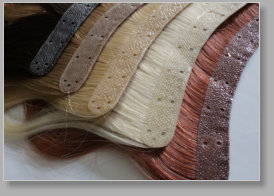
Tape extension: There are two
basic sizes (widths) for these
extensions - 1.5" and 11" width.
A layer of the client’s hair is
laminated on the thin strip skin
of one side, while double face
adhesive tape of the same size
is attached to another skin side.
The concept of a tape extension
is that it is easy to attach onto
the hair by peeling off the
protective waxed tape, then
simply pressing it on client’s
hair. It sticks to hair and lasts
for a few weeks. The main
advantage of this method is that
it is simple to apply and feels
natural when touched. However,
removing tape extensions
requires a special solution or oil
to do the job. Moreover, reusing
tape extensions is much harder
as you need to remove existing
tape, then reapply a new tape
over. Unless you are a
professional, it might be too
complicated to do the job
yourself. Because of simple
attachment, this method is
drawing attention but it is very
hard to reuse the strips after the
initial application.





Ask B.J.

Join our Email List!






Question #4: Are hair extensions
recommended for my thinning top
hair?
Answer #4: In general, the answer is no,
unless your hair is curly and short. The
reason is that attaching hair extensions to
your existing hair, requires the technician
to use a cylinder tube, glue, tape or even
a hair clip. For those who have thin hair
on top, these methods of attachment
show through your hair because a hair
extension is simply a group of thin strands
of hair in a round or flat form. However,
for those who have short and curly hair,
the thin hair on top can be easily covered
by using extensions.
Question #5: What is the right type of
Human Hair Extension to choose?
Answer #5: It is important to choose the
right type of hair extension based on your
hair condition, style, and how it fits into
your life style. Therefore, it is important to
consult with a hair professional who
covers both the field of hair extensions
and hair replacement.
Question #6: If hair extensions are
not right for me, what other method
should I consider?
Answer #6: You need to talk to a hair
replacement specialist who knows hair
extension techniques as well. Hair
replacement is a unit that goes on top of
the head to increase density naturally. If a
person has thin hair on top or in the
crown area, the proper way to go is a
partial hair piece or a top piece. A full wig
is designed to cover an entire head while
the partial unit is designed to cover an
exact area of thin hair or bald area.
Note: Watch for the upcoming release
of our exciting new product designed
to meet these needs! Be sure to join
our email list.
Question #7: What types of Human
Hair are being used for hair
extensions?
Answer #7: There are several different
types of human hair being used in the
current marketplace. The main sources
are India and China while European
human hair is limited in quantity. You can
choose Cuticle-Intact human hair which is
healthier than chemically stripped human
hair that has been collected from cuticles
with inverted hair (this type of hair is
usually weaker than cuticle-intact hair and
has a tendency of matting/tangling. Note:
Our product is made of the highest
quality of cuticle-intact hair and has
minimal processing.
Ask B.J.
Question #1: Who can benefit from
100% Human Hair Extensions?
Answer #1: Those individuals who wish to
thicken and/or lengthen the sides and
back of their hair. Also, our pieces are a
perfect solution for those who want to
change their look and style without
making permanent modifications to their
own hair.
Question #2: What is the main
purpose and function of Hair
Extensions?
Answer #2: The basic purpose of hair
extensions is to increase the length and
provide more volume to the client’s
existing hair.
Question #3: What types of Hair
Extensions are available on the
market and how do I choose the right
type and attachment method for me?
Answer #3: Basically, there are 4 types
that are widely available now.
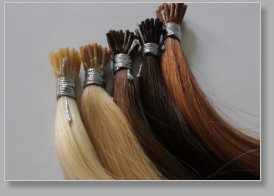
Cylinder tube/”micro ring” method:
These are attached by using a small tube
made out of coated aluminum or copper,
each with pre-glued hair strands. The
strands are then pushed onto a cylinder
tube after a piece of the individual’s own
hair is pulled onto the cylinder. Pressing
the round cylinder flat locks the hair
extension onto existing hair. Note: Our
products include this type of hair
extension.
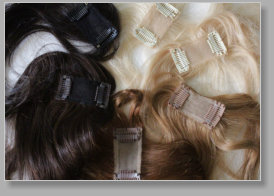
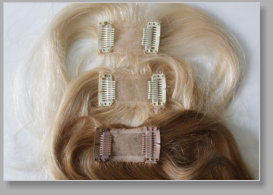
Clip in method: A skirt-like hair drape is
pre-attached with small clips. You can
then simply clip it in onto your existing
hair. You may use one layer or two layers
depending on the required density. Clip in
extensions come in two different strip
widths – short or long. It takes only a few
seconds to install onto existing hair by
simply snapping it on, but like eye glasses,
you may need to remove it at night. It’s
the easiest extension to use and you can
try it on by yourself. This is also the most
economical way to consider hair
extensions before you decide to
permanently attach them. Clip in
extensions outlast any other types of hair
extension and no maintenance service is
required other than to shampoo it once in
a while. Note: Our products include
this type of hair extension.
Conventional weave/braid method:
Using machine made weft, the technician
sews a hair skirt-like weft onto the client’s
existing track line. The process of track
line sewing can pull existing hair, creating
traction Alopecia. Therefore, this method
is not recommended for those who have
weak hair. For those who have strong hair,
the method can be beneficial and machine
made hair is rather inexpensive.
Glue method: Using pre-glued individual
extensions in a round or U shape form,
each piece is individually attached to the
same amount of client hair by applying
heat, causing the melted glue to attach on
to the hair. Attaching is simple, but
removing the extension can be a problem
depending on the type of glue being used
or the technician’s technique. The
technician may use a solvent or removing
oil which can stress and damage weak
hair. Smaller tiny glue extensions can be
used in the frontal area or temple area of
the head.
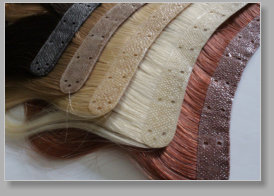
Tape extension: There are two basic
sizes (widths) for these extensions - 1.5"
and 11" width. A layer of the client’s hair
is laminated on the thin strip skin of one
side, while double face adhesive tape of
the same size is attached to another skin
side. The concept of a tape extension is
that it is easy to attach onto the hair by
peeling off the protective waxed tape, then
simply pressing it on client’s hair. It sticks
to hair and lasts for a few weeks. The
main advantage of this method is that it is
simple to apply and feels natural when
touched. However, removing tape
extensions requires a special solution or oil
to do the job. Moreover, reusing tape
extensions is much harder as you need to
remove existing tape, then reapply a new
tape over. Unless you are a professional,
it might be too complicated to do the job
yourself. Because of simple attachment,
this method is drawing attention but it is
very hard to reuse the strips after the
initial application.




Ask B.J.

Join our Email List!


